

Tools & Garage
A dead battery is the single most common reason a car does not start, and most of the time the battery was not actually bad — it was undercharged, sat too long, or spent all winter losing a little every night to the parasitic draw from an alarm and a dozen control modules. A smart charger fixes all three of those situations for less than the cost of one tow, and unlike a jump pack it addresses the cause instead of getting you to work one more time.

The important distinction to get straight before buying: a maintainer keeps a healthy battery topped up over weeks, a charger refills a flat one in hours, and a jump starter does neither — it just dumps current to crank the engine. The three picks below cover the first two jobs at different amperages.
The first filter was simple: anything without automatic voltage regulation was out. Old-style manual chargers will happily boil a modern AGM battery, and the price gap between dumb and smart chargers no longer justifies the risk. From there we looked at chemistry support — AGM, EFB, gel and lithium iron phosphate all want different charge curves, and a charger that only understands flooded lead-acid is a charger you will replace. We also gave real weight to desulfation and repair modes, because the most valuable thing a charger does is recover a battery that a parts-store tester has already written off. Diagnosing a charging complaint properly usually means reading codes too, which our OBD2 scanner guide covers, and if the battery drained because the car sat, our tire inflator guide and oil guide cover the other two things that suffer during storage.

The GENIUS5 is the charger we would buy without thinking about it. Five amps is the sweet spot — it will bring a flat car battery back over a working day rather than a weekend, and it is safe to leave on a stored vehicle for months. The chemistry support matters more every year as AGM becomes standard on cars with stop-start systems, and the force mode is the feature that quietly saves batteries: below about 1 volt, most smart chargers refuse to engage at all because they cannot detect a battery is connected. Being able to override that has rescued a lot of batteries that were headed for the recycler.
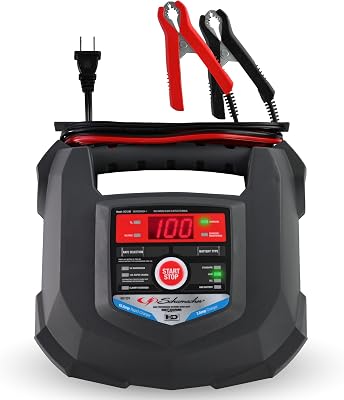
This is the one that lives on the wall of the garage and stays plugged into whatever is not being driven. Schumacher has been making battery equipment for decades and this unit does one job properly: it holds a healthy battery at full charge through a winter without cooking it. It is deliberately low-amperage, which means it is the wrong tool for reviving something that is already flat — you will wait a very long time. Bought for what it is, a set-and-forget maintainer for a seasonal vehicle, it is excellent and inexpensive.

When the car needs to move today rather than tomorrow, amperage is the whole argument. Ten amps will refill a typical car battery in a few hours instead of overnight, and the 25-amp engine-start mode gives you enough current to crank after a brief charge — which is the practical difference between this and the GENIUS5 on a cold morning. It is also the pick if you are dealing with group 31 truck batteries or an RV bank, where five amps starts to feel theoretical. The trade-off is that it is a bigger, less refined unit, and it lacks the lithium support the NOCO has.
| Pick | Output | Best for | Chemistry support | Owner rating | Link |
|---|---|---|---|---|---|
| NOCO Best Overall |
5A (6V/12V) | Everyday charging and long-term maintenance | Flooded, gel, AGM, EFB, lithium | 4.6★ (21,000+) | Check Price |
| Schumacher Best Maintainer |
Low-amp float (6V/12V) | Winter storage on a healthy battery | Lead-acid | 4.6★ (9,500+) | Check Price |
| TowerTop Best High-Amp |
2/10/25A (12V) | Fast recharge and large batteries | Lead-acid, AGM | 4.5★ (5,800+) | Check Price |
Amperage determines how fast a charger refills a battery, and more is not automatically better. Under about 2 amps you have a maintainer — useful for holding a charge, useless for recovering one. Around 4 to 10 amps is the general-purpose range that will bring a flat car battery back in a working day without stressing it. Above 15 amps you are into fast-charge territory that suits large truck and marine batteries but generates real heat on a small one. For a single car in a driveway, 5 amps is the right answer far more often than 25.
AGM batteries — now standard on most stop-start vehicles — want a higher, tightly controlled absorption voltage than flooded lead-acid, and a charger that does not know the difference will either undercharge them for years or overcharge them into early failure. Lithium iron phosphate packs, common in powersports, need a completely different curve again and can be damaged by a lead-acid profile. Find out what is in your car before you buy, and pick a charger that names your chemistry explicitly rather than one that says "all batteries."
When a lead-acid battery sits partially discharged, sulfate crystals form on the plates and progressively reduce capacity. That is what has usually happened to a battery that reads fine on voltage but cannot crank. A charger with a desulfation or repair mode applies controlled pulses to break those crystals down, and it genuinely recovers batteries that a parts-store load tester has already condemned. It does not work every time — a battery with a physically shorted cell is finished — but recovering one battery covers the cost of the charger.
These get conflated constantly and they solve different problems. A jump starter is a portable battery that delivers a large burst of current to crank an engine, then you drive off and the alternator does the rest. A charger is a mains-powered device that slowly and properly refills the battery itself. If your battery keeps dying, a jump starter treats the symptom every single morning while a charger addresses the cause. If your battery dies once because you left the lights on, either will get you going — but only the charger will bring the battery back to full health afterward, because an alternator is designed to maintain a charge, not to restore a deeply discharged one.
The NOCO GENIUS5 is the right charger for almost everyone — enough amperage to be useful, gentle enough to leave connected, and the broadest chemistry support of the three. If you are storing a vehicle for a season and the battery is healthy, the Schumacher maintainer is cheaper and does that one job perfectly. If you need a truck or RV battery back in service the same day, the TowerTop's 25-amp mode is the reason to buy it. Just be clear which of the three problems you actually have.
Prices change constantly, so we do not list them. These links go straight to each product on Amazon.
NOCO → Schumacher → TowerTop →With a 5-amp smart charger, a typical 50Ah car battery that is significantly discharged takes roughly 8 to 12 hours to reach full. At 10 amps, expect around 4 to 6 hours. Maintainers under 2 amps are not designed to recharge at all — they hold an already-full battery, and asking one to revive a flat battery can take days. A smart charger will hold at float once complete, so overnight charging is safe and is usually the easiest approach.
Yes, provided it is a smart charger with automatic float or maintenance mode — all three picks here qualify. Once the battery reaches full, the charger drops to a trickle that offsets self-discharge without overcharging. Older manual chargers without regulation should never be left connected: they will keep pushing current, boil off electrolyte, and destroy the battery.
Sometimes. If the battery is simply discharged — lights left on, car sat for a month — a charger will bring it back completely. If it is sulfated from sitting partially discharged for a long time, a charger with a desulfation mode has a reasonable chance of recovering usable capacity. If a cell is physically shorted or the battery will not hold voltage after a full charge cycle, it is finished and no charger will change that.
Usually no. Modern smart chargers are safe to use with the battery still installed and connected, which is how most people use them. Connect positive first, then negative to a clean chassis ground away from the battery rather than directly to the negative post — that keeps any spark away from the hydrogen a charging battery vents. If your vehicle's manual specifically says to disconnect, follow the manual.
Amperage and intent. A charger delivers enough current to meaningfully refill a discharged battery in hours. A maintainer delivers a fraction of an amp — just enough to offset natural self-discharge and parasitic draw on a battery that is already full. Most modern smart chargers, including the NOCO here, do both: they charge at full rate, then automatically drop to maintenance once the battery is topped up.


Every product on this page was located and verified on Amazon at the time of writing — we confirm the exact listing, the star rating, the review count and stock status before a product goes in a roundup, and we never recommend a product we could not verify. Specifications come from the manufacturer listing, not from memory. We deliberately publish no prices, because they change faster than we can update pages. Ratings and review counts were accurate as of July 19, 2026.