

Electrical & Batteries
Underinflated tires are the most common and most ignored problem on the road. They wear the shoulders out early, cost real fuel economy, make the car handle worse in exactly the conditions where you want it handling well, and they get that way slowly enough that nobody notices — a tire loses about a pound of pressure a month on its own, and more in cold weather. A tire inflator in the trunk turns a recurring annoyance into a two-minute job in the driveway.

What separates a good one from a bad one is not the headline PSI number, which nearly every unit inflates. It is fill time under real load, gauge accuracy against a known-good reference, and whether the compressor can do all four tires without shutting down to cool off.
Fill time is the number that matters and the number nobody publishes honestly, so we weighted toward units where a large body of owners independently report the same real-world timings. Beyond that we looked for three things: an auto-shutoff that stops at the pressure you set rather than five PSI past it, a duty cycle that survives four tires in sequence without a thermal cutout, and a power arrangement that suits how the thing will actually be used — a 12V-only unit is useless if the car battery is the reason you are stranded. We rejected anything under 25 reviews. If you are building out a roadside kit, our battery charger guide covers the other half of the not-getting-stranded problem, and brake pads and car vacuums round out the driveway-maintenance set.
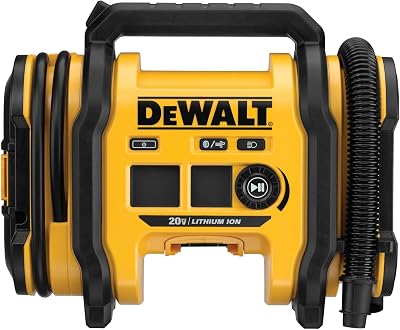
This is the one that behaves like a tool rather than a gadget. The three power sources are the headline feature and they matter more than they sound: if the reason you are inflating a tire is that something went wrong, being able to run off a cordless battery instead of a car that may not start is the difference between solving the problem and not. The auto-shutoff is accurate enough to trust, the housing survives being thrown in a truck bed, and the high-volume mode means it doubles as the camping pump. If you already own DEWALT 20V batteries the value is obvious; even buying a battery alongside it, this is the pick we would make.
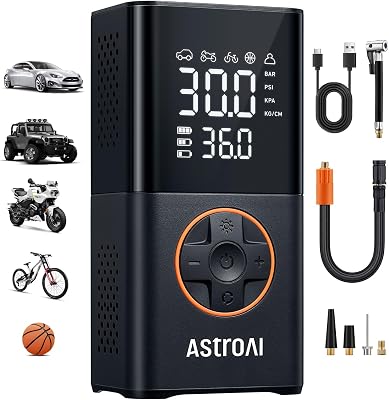
The L7 is the cordless inflator to buy if you are not already invested in a tool battery platform. Everything is self-contained, it holds enough charge to do a set of car tires from a few PSI low, and the preset shutoff works as advertised. The 4.4-star average is honest about where it sits: it is slower than the DEWALT on a large truck tire, the fan is loud, and a minority of owners report battery longevity dropping after a couple of years. For topping up four tires once a month in a driveway, none of that matters much, and the price gap is real.

The best tire inflator is the one that is actually in the car when you need it, and this is the one small enough that it stays there. The Airmoto is genuinely pocketable, which is the entire argument for it. Be realistic about the trade-off, though: a compressor this size has a small motor and a short duty cycle, so it is slow on a full-size truck tire and it wants a rest between tires. As a bicycle pump and a top-up-a-soft-tire tool it is excellent. As your only inflator for a heavy vehicle, it will frustrate you. At 4.3 stars across 28,000 ratings, that is roughly what owners say too.
| Pick | Power source | Max pressure | Best for | Owner rating | Link |
|---|---|---|---|---|---|
| DEWALT Best Overall |
20V battery / 12V / 110V | 160 PSI | Trucks, trailers, doing everything | 4.6★ (18,000+) | Check Price |
| AstroAI Best Value |
Built-in rechargeable | 150 PSI | Cordless driveway top-ups | 4.4★ (16,000+) | Check Price |
| Airmoto Best Compact |
Built-in rechargeable (USB) | Compact-duty | Glovebox carry, bikes | 4.3★ (28,000+) | Check Price |
A 12V-socket inflator is cheap and effectively unlimited in runtime, but it needs a running vehicle — which is a problem if the car will not start. A cordless unit with a built-in battery works anywhere, including on a bicycle at the far end of a trail, but has finite runtime and a battery that ages. A tool-platform inflator like the DEWALT splits the difference and is the most flexible if you already own the batteries. Think about the worst-case scenario you are buying for, not the everyday one.
Almost every consumer inflator claims 120 to 160 PSI, and almost none of them will be asked for more than 40. What actually varies is how long it takes to move air. A compact unit might take four or five minutes to bring a car tire up 10 PSI; a full-size compressor does it in under two. On a light truck or SUV with larger air volume, that gap widens considerably. If you drive something big, buy for airflow, not for the number on the box.
Built-in digital gauges vary, and a unit that reads two PSI optimistic will leave every tire on the car slightly soft. When your inflator arrives, set a tire with it and then check that tire with a separate pencil or dial gauge. If there is a consistent offset, note it and compensate. This takes five minutes once and it is the difference between a tool you can trust and one you are guessing with.
Small compressors generate a lot of heat, and many have a thermal cutout that trips after several minutes of continuous running. On a car that is fine — you are doing 30 seconds per tire. Starting from properly flat, or working on four large truck tires in sequence, is where a short duty cycle becomes obvious and irritating. Owner reviews are the only reliable source here; look specifically for people describing doing all four tires in one session.
The DEWALT 20V MAX is the inflator to buy if you want one tool that handles everything — three power sources, a gauge you can trust, and the airflow to deal with truck tires. The AstroAI L7 gets you most of the way there cordless for meaningfully less, and is the right call for a normal car. The Airmoto is not really competing with either; it is the one that lives in the glovebox permanently and saves you on the day you need it. Whichever you pick, check its gauge against a reference once before you rely on it.
Prices change constantly, so we do not list them. These links go straight to each product on Amazon.
DEWALT → AstroAI → Airmoto →Use the placard on the driver's door jamb, not the number molded into the tire sidewall. The sidewall figure is the tire's maximum safe pressure; the door placard is the pressure the vehicle manufacturer specified for that car's weight and suspension. Most passenger cars land between 32 and 36 PSI cold. Check when the tires are cold — driving heats the air and can add several PSI, which will make a correctly inflated tire look overinflated.
With a full-size portable compressor, roughly 1 to 2 minutes to bring a car tire up by 10 PSI. A compact glovebox unit will take three to five minutes for the same job. Inflating a completely flat tire from zero takes considerably longer — 5 to 10 minutes on a car, and longer on a truck — and is where a small compressor's thermal cutout is most likely to interrupt you.
Yes, as long as the tire is still seated on the rim and the leak is not faster than the compressor. If the tire has come off the bead, a portable inflator cannot reseat it — that needs a burst of high volume that these units do not produce, and it is a tire shop job. If there is a puncture, an inflator buys you enough pressure to drive to a repair, not a permanent fix.
Cordless if you want it to work when the car does not, or if you will use it away from a vehicle. A 12V-socket unit if you mainly top up tires at home, want unlimited runtime, and do not want a battery to maintain. The DEWALT's advantage is that it does both, which removes the decision entirely.
Monthly, and before any long trip. Tires lose roughly 1 PSI per month naturally, and about 1 PSI for every 10°F drop in ambient temperature — which is why so many TPMS lights come on the first cold morning of autumn. A TPMS warning typically does not trigger until a tire is about 25% underinflated, so by the time the light is on you have already been driving on soft tires for a while.


Every product on this page was located and verified on Amazon at the time of writing — we confirm the exact listing, the star rating, the review count and stock status before a product goes in a roundup, and we never recommend a product we could not verify. Specifications come from the manufacturer listing, not from memory. We deliberately publish no prices, because they change faster than we can update pages. Ratings and review counts were accurate as of August 3, 2026.