

Tools & Garage
Wheel chocks are the cheapest safety item you can put in a garage and the one most people skip. A handbrake acts on two wheels, usually the rears, through a cable that stretches over time. Park pawls in automatics are a small piece of metal engaging a toothed ring, and they are not designed to be the only thing holding a car. Neither is doing anything at all for the wheels you are about to lift off the ground.

The moment you jack one corner of a car, its weight redistributes and whatever was holding it becomes less effective. Chocks are what stop a car rolling off a jack, and that is not a hypothetical failure mode. All three below are rated well above what a passenger car needs, and the differences are material, grip and how much space they take up.
Material and base grip decided this. Solid rubber outperforms moulded plastic on a smooth garage floor, which is exactly the surface where a chock sliding rather than holding actually matters, and it tolerates oil and cold far better. We looked for a stated GVW rating rather than a vague weight claim, and preferred four-packs, because chocking properly means both sides of a wheel or both axles rather than a single wedge behind one tyre. Storage size counted too — chocks that live in a boot get used and ones that live on a shelf do not. Chocking is step one of lifting a car safely: see our guides to the best jack stands and the best tire repair kits for the rest of that job.
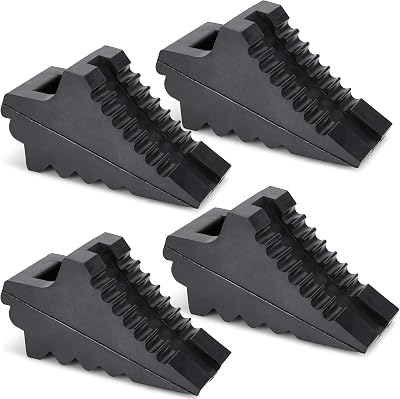
Four chocks is the right quantity and most sets give you two. Chocking properly means blocking the wheel in both directions, or blocking both wheels on the axle staying down, and with a pair you are always compromising on one of those. AFA rates these to 8 tonnes GVW, which is enormous overkill for a car and exactly the margin you want in a safety item. The base texture is the part that matters on a garage floor — a chock that slides on smooth sealed concrete is decorative. At 4.8 stars across three thousand owners this is the straightforward recommendation.

This is the pack to keep in the car rather than the garage. Solid rubber gives you the grip that matters, the handles mean you can position them without getting oil on your hands, and they are small enough that they actually stay in the boot instead of being taken out to make room. Two chocks covers the standard case — blocking the axle that stays on the ground while you lift the other end. If you want to block a wheel in both directions, or you park on a slope regularly, buy four of something instead.

If your garage floor is sealed or painted concrete, grip is the only specification that matters, and this is where HOXWELL earns its place. The compound is noticeably denser than typical chocks and the base pattern is more aggressive, which translates into a chock that stays where you put it when the car settles onto it. They are heavier to handle as a result, which is a fair trade for a tool that lives on the floor. The rating matches our top pick at 4.8; the smaller review base and the lack of a stated GVW figure are the only reasons it sits third.
| Pick | Material | Quantity | Rating claim | Owner rating | Link |
|---|---|---|---|---|---|
| AFA Tooling Best Overall |
Anti-slip base | 4-pack | 8 tonnes GVW | 4.8★ (3,000+) | Check Price |
| SECURITYMAN Best Value |
Solid rubber | 2-pack | Heavy duty | 4.6★ (2,040+) | Check Price |
| HOXWELL Best Grip |
Dense solid rubber | 4-pack | Heavy duty | 4.8★ (1,500+) | Check Price |
A handbrake acts on two wheels through a cable that stretches with age, and many are adjusted poorly. An automatic's park pawl is a small pin engaging a ring gear — it holds a stationary car on level ground and was never intended as a jacking restraint. Once you lift one corner, weight shifts and both become less effective. Chocks are a mechanical block that does not depend on any of that.
Place chocks at the axle opposite the one you are lifting. Lifting the front? Chock the rear wheels. Ideally block each chocked wheel both in front and behind, which is why four-packs are worth the small extra cost — a car can roll either way as weight transfers, and blocking only the downhill side assumes you know which way it will go.
Moulded plastic chocks are lighter and cheaper and they slide on smooth sealed concrete, which is where most people actually work on cars. Solid rubber grips, tolerates oil, and does not become brittle in cold weather. The base pattern matters as much as the material — a flat-bottomed rubber chock on painted concrete is not much better than plastic.
A chock that is too small rides under the tyre rather than blocking it. As a rough guide the chock should reach at least a quarter of the wheel's radius. More importantly: none of this makes a slope safe. Work on level ground, on concrete rather than asphalt or gravel, and treat chocks as one layer of protection alongside jack stands — not as a substitute for either.
For garage use the AFA Tooling 4-pack is the buy — four chocks, an 8-tonne GVW rating and a base that grips sealed concrete. If you want a pair to live in the boot, SECURITYMAN's solid rubber pack is compact and well rated. If your floor is smooth and slippery, HOXWELL's denser compound has the most bite. Chock the axle that stays down, work on level concrete, and use them alongside jack stands rather than instead of them.
Chocks are the cheapest part of not being under a moving car. See how to change a tire for where they go relative to the wheel you are lifting.
Prices change constantly, so we do not list them. These links go straight to each product on Amazon.
AFA Tooling → SECURITYMAN → HOXWELL →Yes. A handbrake works on two wheels through a cable that stretches over time, and an automatic's park pawl is a small pin in the transmission that was never designed as a jacking restraint. Lifting one corner of a car redistributes weight and reduces the effectiveness of both. Chocks are a physical block that does not rely on either system.
At the axle that stays on the ground. If you are lifting the front, chock the rear wheels; if lifting the rear, chock the fronts. Where possible block each wheel on both sides so the car cannot roll in either direction, because weight transfer during lifting is not always predictable.
Rubber, for garage use. Solid rubber grips smooth sealed concrete, resists oil and stays flexible in the cold. Plastic chocks are lighter and cheaper but slide on exactly the surface most people work on. Whichever material, check the base is textured rather than flat — grip comes from the pattern as much as the compound.
Big enough that the chock blocks the tyre rather than being pushed under it — roughly a quarter of the wheel's radius in height is a reasonable guide. Larger and heavier vehicles need proportionally bigger chocks. Most chocks sold for cars, trailers and RVs cover passenger vehicles comfortably; the ratings are usually far above what a car requires.
No. They solve different problems. Chocks stop a car rolling; jack stands hold its weight once it is lifted. Never get under a vehicle supported only by a jack, chocked or not. Use chocks first, lift with the jack, lower onto stands, then shake the car before going underneath.


Every product on this page was located and verified on Amazon at the time of writing — we confirm the exact listing, the star rating, the review count and stock status before a product goes in a roundup, and we never recommend a product we could not verify. Specifications come from the manufacturer listing, not from memory. We deliberately publish no prices, because they change faster than we can update pages. Ratings and review counts were accurate as of August 9, 2026.