

Brakes & Suspension
Almost every fastener on a car has a specified torque, and almost nobody checks. For most bolts you will get away with it. For wheels you will not, and the failure modes go in both directions: under-tightened lug nuts work loose, and over-tightened ones stretch studs and warp brake rotors, which is the actual cause of a great deal of the steering-wheel shudder people blame on cheap rotors.

A click-type torque wrench solves this for less than the cost of one warped rotor. You set the value, pull until it clicks, and stop. The three below cover the two drive sizes that matter for car work — half-inch for wheels and suspension, three-eighths for the smaller fasteners inside the engine bay. One note on the category before you read on: it is dominated by two brands with very large review bases, and the alternatives are thin. We say more about that under our third pick, because it is relevant to how much weight to give its rating.
Accuracy specification came first — a wrench that cannot hold roughly four percent is not doing the job you bought it for — followed by whether the mechanism gives a click you can actually feel through a socket and extension. We preferred wrenches that ship with a calibration certificate or a stated accuracy figure over ones that stay vague. Drive size drove the selection as much as brand: half-inch is the size for wheels and suspension, three-eighths for smaller fasteners, and a roundup of three half-inch wrenches would not have been useful. Torque wrenches sit alongside jobs covered in our guides to the best brake pads and the best tire repair kits, both of which end with wheels that need torquing properly.

This is the wrench most people should own, and the review base is the argument. Twenty-three thousand ratings is a sample size that exposes long-term problems — mechanisms that drift, clicks that get vague, adjustment collars that slip — and it has held at 4.6 stars through all of it. The range is well chosen: 10 to 150 ft-lb comfortably brackets the 80 to 100 ft-lb where most lug nut specifications sit, and using a wrench in the middle of its range is where click mechanisms are most accurate. It is not a beautifully finished tool and the scale takes a moment to read in poor light. It is accurate, durable and inexpensive, which is the correct set of priorities for a tool most owners use a few times a year.

LEXIVON is what you buy if you will use this more than a few times a year. It does the same job as the EPAuto to the same specification, and what you get for the difference is the experience of using it: a crisper click, a collar that locks positively rather than creeping, and a dual-scale marking that is genuinely easier to read lying on your back under a car. Across nearly twelve thousand ratings it holds a marginally higher score than our top pick. The reason it is not the overall recommendation is simply that the extra refinement does not change the outcome — a correctly torqued lug nut is correctly torqued either way — and the EPAuto has twice the review depth behind it.
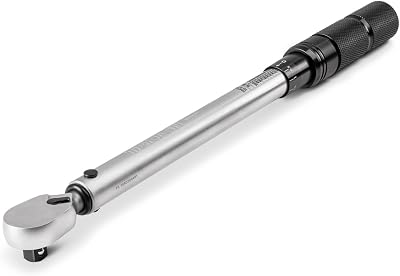
We are including this with a caveat we want to be explicit about, because it cuts against our usual standard. This site prefers a good rating with a large review base over a high rating with a handful, and 64 reviews is a handful. We included it anyway for two reasons: a half-inch wrench is genuinely the wrong tool for a 20 ft-lb fastener — it is at the bottom of its range where click mechanisms are least accurate — so a three-eighths drive belongs in this roundup, and TEKTON is a long-established hand tool brand rather than an anonymous listing. Buy this for the drive size and the brand, not because 4.8 from 64 people means what 4.6 from 23,500 does. If you would rather have depth of feedback than a 3/8 click wrench, the Neiko beam below covers small fasteners with two thousand owners behind it.

A beam wrench is a flat spring with a pointer. There is no spring-loaded mechanism, no click, and therefore nothing to drift — which makes it the honest answer to the biggest weakness of every other wrench on this page. A click wrench stored under tension quietly stops being accurate and keeps clicking anyway; a beam wrench either reads correctly or is visibly bent. For a home garage where the tool sits unused for months between jobs, that is a genuine advantage. The trade is real: you have to watch the scale as you pull, so it is awkward in tight spaces and unusable where you cannot see the gauge. At 1/4-inch drive this one is aimed at small fasteners, and with 2,190 ratings it carries far more feedback than our TEKTON pick.

This is the beam wrench for people who want one tool rather than two. The dual-drive adapters take it from engine bay fasteners up into lug nut territory, which the 1/4-inch Neiko cannot reach. Across two thousand ratings it holds 4.4 — the lowest here, and reading the complaints they cluster on the printed scale being hard to read at a glance rather than on accuracy. That is a fair criticism of beam wrenches generally: the number is only as good as your view of it. If you want the never-goes-out-of-calibration argument to cover wheels as well as small work, this is the one that does.

Digital wrenches solve a specific problem: a click is easy to miss when you are braced awkwardly under a car, and overshooting past the click is one of the commonest ways fasteners get over-torqued. This one warns you as you approach the target and confirms the peak value afterwards, which removes the guesswork entirely. It is also the one credible digital option we found — most digital torque wrenches on Amazon sit on a few hundred ratings, and this carries over eleven hundred. The 4.4 rating and the battery dependence are the honest trade-offs. Buy it if you torque fasteners often enough that a missed click matters; buy the EPAuto if you do not.
| Pick | Type | Drive | Best for | Owner rating | Link |
|---|---|---|---|---|---|
| EPAuto Best Overall |
Click | 1/2 inch | Wheels, suspension | 4.6★ (23,500+) | Check Price |
| LEXIVON Best Premium |
Click | 1/2 inch | Frequent use, better feel | 4.7★ (11,900+) | Check Price |
| TEKTON Best for Smaller Fasteners |
Click | 3/8 inch | Engine bay fasteners | 4.8★ (64 only) | Check Price |
| Neiko Best Beam-Type |
Beam | 1/4 inch | Small fasteners, no calibration to lose | 4.6★ (2,190+) | Check Price |
| Tooluxe Best Dual-Drive Beam |
Beam | 3/8 and 1/2 inch | One beam wrench for everything | 4.4★ (2,070+) | Check Price |
| GEARWRENCH Best Digital |
Digital | 1/2 inch | Never missing the target value | 4.4★ (1,130+) | Check Price |
Half-inch drive is the size for wheels, suspension components and anything else needing serious torque — it is what you want if you are buying one wrench. Three-eighths covers the 15 to 75 ft-lb range where most engine bay fasteners live. Quarter-inch is for small interior and electrical work. Using a large wrench at the very bottom of its range is a real accuracy problem, not a theoretical one, which is why owning two eventually makes sense.
This is the maintenance step nobody is told about and it is the main reason click wrenches drift out of calibration. The mechanism works against a spring, and storing it wound to 100 ft-lb leaves that spring compressed for months. Wind it back to the bottom of its scale — not past it — before it goes in the case. Doing this consistently is the difference between a wrench that stays accurate for years and one that quietly stops being a measuring tool.
The click is the signal that you have reached the set value. Continuing to pull past it keeps tightening and defeats the entire purpose. Pull smoothly rather than jerking, because a sharp yank can overshoot before the mechanism releases. Never use a torque wrench to break fasteners loose either — that is what a breaker bar is for, and using a calibrated instrument as a lever is how it stops being calibrated.
Most passenger cars specify somewhere between 80 and 100 ft-lb, but check your manual rather than assuming. Tighten in a star pattern, in stages, and do the final pass with the wheel on the ground. Over-tightening is the more common error and the more expensive one: it stretches studs and distorts the rotor hat, which produces exactly the pulsing brake pedal that gets misdiagnosed as warped rotors. Impact wrenches at tire shops are the usual culprit, which is a good reason to re-torque your wheels yourself after a fitting.
For most people, the EPAuto half-inch wrench is the buy — accurate, well-ranged for wheel work, and backed by a review base nothing else here approaches. If you will use it often and want a better tool in the hand, the LEXIVON is the same specification done more nicely. If you are torquing smaller engine bay fasteners, a three-eighths drive is the correct tool and TEKTON's is our pick — with the caveat that its review base is thin and we would rather say so than pretend 64 ratings carry the weight of 23,500. Wind whichever you buy back to zero before you put it away.
A torque wrench earns its place on jobs where a guess is expensive. Both changing brake pads and changing spark plugs are ones where the specification genuinely matters.
Prices change constantly, so we do not list them. These links go straight to each product on Amazon.
EPAuto → LEXIVON → TEKTON → Neiko → Tooluxe → GEARWRENCH →For wheels, yes. Under-tightened lug nuts can work loose, and over-tightened ones stretch the studs and distort the rotor, producing a pulsing brake pedal that people usually blame on the rotors themselves. Both outcomes are avoidable with a tool that costs less than one rotor replacement. For most other fasteners you can work by feel; wheels are the exception worth owning the tool for.
Wind the adjustment back to the lowest setting on the scale — not below it — and keep it in its case. Click wrenches work against an internal spring, and storing one at a high setting keeps that spring compressed, which is the main cause of calibration drift. Keep it away from damp, and do not throw it loose in a toolbox where it can be dropped.
Manufacturers commonly suggest annually or every five thousand cycles, whichever comes first. For a home user torquing wheels a few times a year, that is conservative — if you store it properly and never drop it, a quality wrench holds accuracy for years. Dropping one is the event that should prompt a recalibration, because impact can shift the mechanism in ways that are not visible.
Typically 80 to 100 ft-lb on passenger cars, but this varies by vehicle and you should use the figure in your owner's manual rather than a general number. Trucks and larger vehicles often specify considerably more. Tighten in a star or criss-cross pattern rather than going around the circle, and finish the torquing with the wheel on the ground so the hub cannot rotate.
No. A torque wrench is a measuring instrument and using it to break tight fasteners loose can damage the mechanism and cost you its accuracy. Use a breaker bar or a standard ratchet to loosen, then fit the torque wrench for final tightening only. This is the most common way people quietly ruin an otherwise good wrench.


Every product on this page was located and verified on Amazon at the time of writing — we confirm the exact listing, the star rating, the review count and stock status before a product goes in a roundup, and we never recommend a product we could not verify. Specifications come from the manufacturer listing, not from memory. We deliberately publish no prices, because they change faster than we can update pages. Ratings and review counts were accurate as of August 24, 2026.