

Tools & Garage
A code reader tells you what the car thinks is wrong. A multimeter tells you what is actually happening in the wire. That distinction is the whole reason to own one: an OBD2 scanner will report a circuit fault, and a multimeter is how you find out whether the problem is the sensor, the connector, the ground, or the wiring between them.

It is also the tool that answers the two most common car questions without guesswork. Is the battery actually flat, or is the alternator not charging it? Something is draining the battery overnight — what? Both are ten-minute jobs with a meter and impossible without one. You do not need an expensive one. You need one with accurate DC volts, a decent safety rating and leads that do not fall apart, and all three below qualify.
Automotive work is almost entirely DC voltage, resistance and continuity, so we weighted DC accuracy and a usable continuity beeper far above the exotic functions meters get marketed on. Auto-ranging matters more than it sounds when you are under a dash holding a probe in each hand. We also looked at lead quality, since cheap leads are the first thing to fail and the most common reason a meter gets replaced, and at CAT safety rating — a 12V system will not hurt you, but hybrid and EV traction circuits absolutely will. A multimeter is the natural companion to a code reader: see our guides to the best OBD2 scanners and the best jump starters for the two tools that sit either side of it in a diagnosis.

Fifty-five thousand ratings is the argument. This is the meter that sits in an enormous number of home garages, and at that sample size you are reading a decade of real use rather than launch-week enthusiasm. For car work it does everything required: DC volts to check a battery at rest and under crank, resistance to test a sensor against spec, continuity to find the break in a harness. The honest limits are that it is manual-ranging, so you select the scale yourself, and the supplied leads are adequate rather than good. Neither stops it being the right first meter, and at 4.5 stars the complaints are mostly about those leads.

Auto-ranging is the upgrade you feel every single time you use the meter. Rather than guessing whether a reading will land on the 20V or 200V scale, you turn the dial to volts and probe. Under a dashboard with a probe in each hand and a torch in your teeth, that is a genuine improvement rather than a spec-sheet one. True RMS is less relevant to pure 12V DC work but costs nothing here and matters the moment you measure anything at home. At 4.6 stars across twenty-three thousand ratings this is the meter to buy if you already know you will use it regularly.
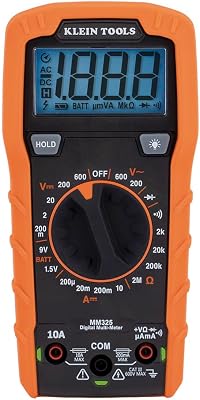
Klein makes tools for electricians who use them daily, and the MM325 is built to that standard rather than to a price. If you have ever had a meter stop working because a lead frayed at the plug or the case cracked when it fell off the wing, this is the answer to that. Two things to be clear about: the review base is far smaller than our top two picks — 2,870 against 55,500 — and it is manual-ranging, so you are paying for build rather than convenience. Buy it for the durability, not the feature list.

INNOVA is a car-diagnostics company first, and the 3320 is designed around what car owners actually measure rather than what an electrician needs. The battery-condition LEDs are the clearest example: alongside the voltage number you get a direct indication of whether the reading is healthy, which removes the step where people look up what 12.4V means. Auto-ranging makes it easier to use one-handed under a dash than our manual-ranging picks. It will not out-build the Klein and it does not have true RMS, and neither matters much for 12V work. If you want a meter bought specifically for a car, this is it.

This is a different tool rather than a better version of the same one. A standard multimeter measures current by being wired into the circuit, which for a parasitic drain test means disconnecting the battery cable and connecting the meter in series. A clamp meter reads the magnetic field around a conductor instead, so you clamp it over the cable and read — no disconnection, no risk of waking sleeping modules by breaking the circuit. For repeated draw testing that is a genuine advantage. Two caveats: it must read DC amps, since plenty of clamp meters are AC-only and useless on a car, and at 337 ratings the sample is modest — we are weighing Fluke's track record alongside it under our stated standard.
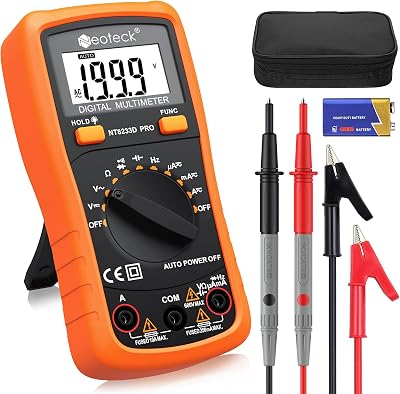
If the meter is going in a drawer for the two or three times a year something electrical goes wrong, this is enough tool. Auto-ranging at this price is the notable part, since our own top pick is manual-ranging and costs more. Across seven thousand ratings it holds 4.5, and reading the complaints they cluster almost entirely on the supplied leads rather than the meter itself — which is a fair criticism and an easy fix, because replacement leads cost very little. Buy the AstroAI if you want the most proven option and this if you want auto-ranging for less.
| Pick | Ranging | True RMS | Best for | Owner rating | Link |
|---|---|---|---|---|---|
| AstroAI Best Overall |
Manual | No | A first meter, most car work | 4.5★ (55,500+) | Check Price |
| KAIWEETS Best Premium |
Auto | Yes | Frequent use, easier under a dash | 4.6★ (23,000+) | Check Price |
| Klein Tools Best Build Quality |
Manual | No | Durability, working conditions | 4.7★ (2,870+) | Check Price |
| INNOVA Best Automotive-Focused |
Auto | No | Car work specifically, battery LEDs | 4.5★ (7,500+) | Check Price |
| Fluke Best Clamp Meter |
Clamp, DC amps | Yes | Parasitic drain without disconnecting | 4.6★ (337) | Check Price |
| Neoteck Best Budget |
Auto | No | Occasional use, lowest cost | 4.5★ (7,100+) | Check Price |
Almost everything you will do on a 12V system is DC voltage, resistance or continuity. AC volts, capacitance, frequency and temperature are on the dial and you will rarely touch them. Do not pay for functions you will not use, and do not accept poor DC accuracy because a meter has a long feature list. The numbers worth knowing: a healthy resting battery reads about 12.6V, and a charging system should show roughly 13.7 to 14.7V with the engine running.
A manual meter needs you to choose the scale before probing; an auto-ranging meter works it out. Manual is cheaper and arguably teaches you more about what you are measuring. Auto-ranging is faster and much easier one-handed, which is the position you are usually in when testing something on a car. Neither is more accurate — this is purely about how the tool feels to use.
If a battery goes flat overnight, this is the test that finds out why. Set the meter to DC amps and connect it in series with the negative battery cable so every bit of current flows through it — most cars settle under about 50 milliamps once their modules go to sleep. Anything higher means something is staying awake, and pulling fuses one at a time isolates the circuit. The timing and the connection order both matter, so we have written it up properly in our guide to using a multimeter on a car, along with the battery and alternator tests.
A 12V system will not hurt you and you can probe it fairly casually. Traction batteries in hybrids and EVs run at several hundred volts and will kill you, and the orange cabling is orange for exactly that reason. Do not go near those circuits without training and correctly rated equipment. Check the CAT rating on any meter you buy, and treat anything that does not clearly state one as unrated.
For most people the AstroAI is the buy — accurate where car work needs it, and backed by a review base nothing else here approaches. If you will use it regularly, the KAIWEETS adds auto-ranging and true RMS, and auto-ranging genuinely improves the experience of working under a dash. If your tools live rough, the Klein MM325 is the best-made of the three and rated highest, with a much smaller review base. Any of them will find a parasitic drain, which is the job that pays for the tool.
A meter is worth having only if you know what to probe. The most common job it settles is testing an alternator — thirty seconds that tells you whether to replace the battery or the thing draining it. Our guide to using a multimeter on a car covers parasitic draw and continuity as well, and testing ignition coils puts it to work on a misfire.
Prices change constantly, so we do not list them. These links go straight to each product on Amazon.
AstroAI → KAIWEETS → Klein Tools → INNOVA → Fluke → Neoteck →About 12.6V at rest with the engine off and the battery settled. Around 12.4V is roughly 75 percent charged, and 12.0V or below is significantly discharged. With the engine running you should see roughly 13.7 to 14.7V, which confirms the alternator is charging. A battery that reads fine at rest but collapses under load may still be failing — resting voltage is only half the picture.
Let the car sit until its modules go to sleep, typically 30 to 60 minutes. Set the meter to DC amps, disconnect the negative battery cable, and connect the meter in series between the cable and the terminal so all current flows through it. Most vehicles settle below about 50 milliamps. If the draw is higher, remove fuses one at a time and watch for the reading to drop.
Not really. True RMS matters when measuring AC waveforms that are not clean sine waves, and car work is overwhelmingly DC. It is a nice thing to have if the meter also lives in the house, and it costs little on modern meters, but do not choose a worse meter for car work in order to get it.
A scanner reads what the car's computer reports about itself — fault codes, live sensor data, freeze frame. A multimeter measures actual electrical values in a circuit. A scanner will tell you a sensor circuit is faulty; a multimeter tells you whether the sensor, the wiring or the ground is at fault. They answer different questions and serious diagnosis usually needs both.
On the 12V system, yes, exactly as on any car. On the high-voltage traction system, no — not without proper training and equipment rated for it. Those circuits run at several hundred volts, are marked with orange cabling, and are genuinely lethal. This is not an abundance of caution; it is the one place in car maintenance where a mistake can kill you.


Every product on this page was located and verified on Amazon at the time of writing — we confirm the exact listing, the star rating, the review count and stock status before a product goes in a roundup, and we never recommend a product we could not verify. Specifications come from the manufacturer listing, not from memory. We deliberately publish no prices, because they change faster than we can update pages. Ratings and review counts were accurate as of August 24, 2026.