

Electrical & Batteries
A lithium jump starter is the single most useful thing you can put in a trunk. It removes the dependency that makes a dead battery genuinely stressful — needing another car, a stranger willing to stop, and cables long enough to reach. A pack the size of a paperback does the same job by itself, in the dark, in a car park where nobody is around.

The specification everyone shops on is peak amps, and it is close to meaningless. Peak amp figures are measured over a fraction of a second under conditions no real jump replicates, and there is no standard forcing manufacturers to measure them the same way, which is why numbers have inflated year after year. What matters is the engine size the manufacturer will actually commit to, whether the pack has reverse-polarity and spark protection, and whether it still holds charge after six months in a glovebox.
We ignored peak amp claims and sized on the engine displacement each manufacturer states it will start, because that is the number they can be held to. Safety protection was the second filter: reverse-polarity detection and spark-proof clamps are what stop a mistake at 2am from becoming an expensive one, and any pack without them was rejected regardless of rating. We also weighted self-discharge, since a jump starter spends its life sitting unused and one that arrives flat when you need it has failed completely. We rejected listings under roughly 25 reviews. A jump starter deals with the emergency; our guide to the best car battery chargers covers keeping the battery healthy so you need it less, and an OBD2 scanner helps work out why it went flat.

The GB40 is the product every other jump starter is measured against, and the review base is why. A hundred and twenty-eight thousand ratings is more than ten times its nearest competitor here, and at that scale you are not reading marketing — you are reading a decade of people in car parks finding out whether it works. It does. The two things NOCO gets right are the safety system, which will not pass current until the clamps are correctly attached, and the self-discharge rate, which is the difference between a pack that works after eight months in a glovebox and one that does not. It will not start a large diesel; that is what our second pick is for.

If you run a diesel pickup, a large V8, or a van, the GB40 is genuinely under-specified and you should step up rather than hope. GOOLOO is the most credible non-NOCO option we found: 4.6 stars across nearly nine thousand ratings is meaningful depth in a category where most alternatives have a few hundred. Treat the 4000A headline the way you should treat every peak amp number — as marketing rather than measurement — and buy this for the engine sizes GOOLOO states rather than the figure on the box. It is noticeably bulkier than the NOCO, which matters if it is living in a glovebox rather than a truck.
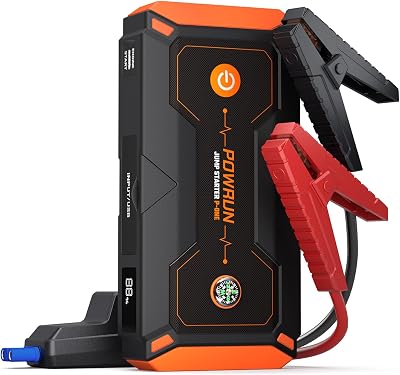
Powrun covers larger engines than the GB40 at a lower cost than either of the picks above, and across six thousand ratings it holds 4.5 stars — solid rather than exceptional, and we would rather say that plainly. The gap to 4.6 sounds trivial and mostly reflects more reports of units arriving with low charge or degrading faster after a couple of years. The case is a genuine practical advantage; loose clamps in a trunk get damaged and tangled. Buy this if cost is the deciding factor and you want diesel-capable headroom. If you want the pack that is most likely to still work in three years, pay for the NOCO.
| Pick | Rated engine size | Safety protection | Extras | Owner rating | Link |
|---|---|---|---|---|---|
| NOCO Best Overall |
Up to 6.0L gas / 3.0L diesel | Spark-proof, reverse-polarity | USB power bank, LED light | 4.6★ (128,600+) | Check Price |
| GOOLOO Best for Big Engines |
Large gas and diesel | Reverse-polarity, short-circuit | Higher capacity pack | 4.6★ (8,800+) | Check Price |
| Powrun Best Value |
Up to 8.0L gas / 6.5L diesel | Reverse-polarity | Carry case included | 4.5★ (6,200+) | Check Price |
Peak amp ratings are measured over a fraction of a second under conditions that do not resemble starting a cold engine, and no standard requires manufacturers to measure them consistently. That is why the numbers keep climbing without the products changing much. The specification worth reading is the engine displacement the manufacturer states the pack will start, in gas and diesel separately — diesels need considerably more because of their compression. Size against that with headroom, and treat the big number on the front as decoration.
Connecting jumper cables backwards can destroy a vehicle's electronics and, in the worst case, the battery itself. A modern lithium pack should refuse to pass current until it detects a correct connection, and its clamps should be spark-proof. This matters most in exactly the circumstances you will use it — dark, cold, tired, in a hurry. Any pack without reverse-polarity protection is not worth the saving.
A jump starter is a device that spends 99 percent of its life doing nothing. The failure people actually experience is not insufficient power, it is reaching for the pack and finding it flat. Lithium packs self-discharge slowly but not at zero, and quality varies widely. Set a calendar reminder to top it up every three to six months, and check it before any long trip — that habit matters more than which pack you buy.
These solve different problems and it is worth being clear about which you need. A jump starter delivers a huge burst of current for a few seconds to crank an engine; it does not recharge the battery, and the alternator does that afterwards as you drive. A charger or maintainer delivers a low current over hours to actually restore charge, and can recover a deeply discharged battery a jump starter cannot help with. If your battery keeps going flat, a jump starter treats the symptom — see our charger guide for the cause.
For most drivers, the NOCO Boost GB40 is the buy, and the review base makes that an easy call — it starts what it claims to start, the safety system is excellent, and it holds charge in storage. If you run a large diesel or a V8, step up to the GOOLOO GP4000, which is the most credible non-NOCO option with real review depth. The Powrun P-ONE covers big engines for less and rates a little lower, which we would rather state than gloss over. Whichever you buy, top it up twice a year.
A jump starter is only as safe as the sequence you use it in. Our guide to jump starting a car explains why the final clamp goes on bare engine metal rather than the battery terminal.
Prices change constantly, so we do not list them. These links go straight to each product on Amazon.
NOCO → GOOLOO → Powrun →Less than the marketing implies, and the amp figure is the wrong thing to shop on. Peak amps are measured over a fraction of a second in conditions unlike a real jump, and there is no standard forcing consistency between brands. Use the engine size the manufacturer states instead: a four-cylinder gas car needs far less than a 6.5L diesel, and every reputable pack publishes both figures.
No, and this is the most common misunderstanding about them. A jump starter provides a brief burst of current to crank the engine; the alternator recharges the battery once the car is running. If a battery is deeply discharged or will not hold charge, you need a proper charger or maintainer to recover it, and possibly a new battery.
Three to five years of useful life is typical, and it depends far more on maintenance than use. Lithium cells degrade whether or not you use them, and letting a pack sit fully discharged for long periods accelerates that badly. Top it up every three to six months and store it somewhere that does not get extremely hot, and you will be at the longer end of that range.
Yes, with a modern pack that has reverse-polarity and spark protection — considerably safer than traditional jumper cables and a second vehicle, since there is no second car's electrical system involved. Connect positive to positive and negative to a bare metal ground point rather than the negative terminal, follow the pack's indicator lights, and do not crank for more than a few seconds at a time.
Usually one of three things: the battery is at the end of its life, typically three to five years; something is drawing current with the car off, known as a parasitic drain; or the alternator is not charging properly. A jump starter gets you moving but treats none of them. An OBD2 scanner and a multimeter will narrow it down, and a battery charger will tell you quickly whether the battery still accepts and holds a charge.


Every product on this page was located and verified on Amazon at the time of writing — we confirm the exact listing, the star rating, the review count and stock status before a product goes in a roundup, and we never recommend a product we could not verify. Specifications come from the manufacturer listing, not from memory. We deliberately publish no prices, because they change faster than we can update pages. Ratings and review counts were accurate as of August 7, 2026.