

Detailing & Car Care
A dual action polisher is the tool that removes swirl marks rather than hiding them. Wax fills them for a few washes. A polisher levels a fraction of the clear coat so the scratches are no longer there, and on dark paint the difference is not subtle — it is the gap between a car that looks cared for and one that looks tired.

The reason to buy a dual action rather than a rotary is safety. A rotary spins on one axis and generates heat fast enough to burn through clear coat in seconds if you dwell in one spot; professionals use them because they cut quickly and they know exactly what they are doing. A DA also oscillates, which spreads the heat and makes burning through very difficult. It is slower and it is far more forgiving, which is the correct trade for anyone who is not doing this for a living.
We looked at throw and speed control first. A larger throw covers ground faster but is harder to manage on curves; variable speed with a genuine soft start is what stops compound flinging across the garage the moment you pull the trigger. We also weighted whether a kit includes usable pads and compounds, because a bare machine plus the wrong pad produces disappointment that gets blamed on the tool. Weight and balance mattered too — a polisher you cannot hold steady for an hour will not finish a car. Polishing sits between decontaminating and protecting: see our guides to the best clay bars for the step before and the best car wax for the step after.

The kit is the reason this takes the top slot. The most common way a first polishing attempt goes badly is not the machine — it is pairing an aggressive pad with a finishing compound or the reverse, getting a poor result, and concluding the tool is bad. Chemical Guys supplies pads and compounds matched to the machine, so the first attempt is set up to work. The TORQX itself is a well-balanced random orbital with proper speed control, and at 4.6 stars across six thousand-plus owners it is the most proven machine here. Experienced detailers will eventually want more power; almost nobody buying their first polisher will.

A smaller pad is genuinely better on real cars, which are full of curves, edges and panels far narrower than six inches. The 5-inch SPTA covers slightly less ground per pass on a bonnet and is much easier to control on a wing mirror, a pillar or around a door handle. It is the highest-rated machine in this roundup. The catch is that it is a bare tool — factor in pads and compound, which erases some of the price advantage over the Chemical Guys kit. Buy it if you already own consumables, or if you know you want the smaller pad.
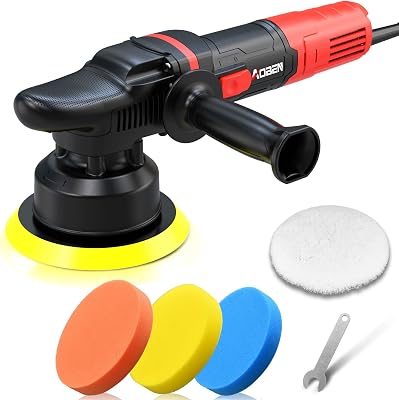
This is the machine for someone testing whether they enjoy machine polishing before committing real money. The soft start matters more than beginners expect: without it, the pad is at full speed before it touches the paint and flings compound everywhere, which is both messy and a waste of product. AOBEN includes that plus six speeds at the lowest price here. The 4.5 rating is the honest caveat, and reading the complaints they cluster on longevity rather than performance — bearings and switches after a couple of years. For a few polishes a year, that is a reasonable trade.
| Pick | Pad size | Kit contents | Best for | Owner rating | Link |
|---|---|---|---|---|---|
| Chemical Guys Best Overall |
6 inch | Machine, pads, compounds | A complete first setup | 4.6★ (6,400+) | Check Price |
| SPTA Best Value |
5 inch | Machine only | Curves and tight panels | 4.7★ (1,830+) | Check Price |
| AOBEN Best for Beginners |
6 inch | Machine, basic pads | Trying it out | 4.5★ (1,580+) | Check Price |
A rotary spins on a single axis, cuts fast and generates heat in one place — dwell for a few seconds and you can burn through the clear coat, which means a respray rather than a polish. A dual action also oscillates, so the contact point constantly moves and heat spreads. It cuts more slowly and it is dramatically harder to damage paint with. Unless you are trained on a rotary, buy the DA.
Pad choice does most of the work. Cutting pads are firm and aggressive, for real defects. Polishing pads are medium, for light swirls. Finishing pads are soft, for applying protection. Pairing an aggressive compound with a soft pad achieves nothing, and pairing a finishing polish with a cutting pad marrs the paint. If you buy a bare machine, budget for a proper pad set and match pad to compound.
This is the thing to understand before you start. Every polish takes away a thin layer of clear coat, and there is a finite amount — typically enough for a handful of proper corrections over a car's life. Polish when there are defects worth removing, not as a seasonal ritual. Between corrections, wash properly and protect, which is what stops the swirls coming back.
Two by two feet at a time, overlapping passes, machine constantly moving, light pressure — the machine does the work. Always start with the least aggressive pad and compound that might work and step up only if it does not. And do a test section on an inconspicuous panel first: paint hardness varies enormously between manufacturers, and the combination that corrects one car will be too aggressive on another.
For a first polisher the Chemical Guys TORQX kit is the right buy, because it arrives with pads and compounds that match the machine and that is where first attempts usually go wrong. The SPTA 5-inch is rated highest here and its smaller pad is genuinely better on curves — buy it if you already have consumables. AOBEN is the low-cost way to find out whether you enjoy this. Whichever you choose, test on a small area first and remember that clear coat is finite.
A polisher is the tool for a job worth understanding first. Our guide to removing scratches from a car covers the fingernail test that tells you whether polishing will fix it at all.
Prices change constantly, so we do not list them. These links go straight to each product on Amazon.
Chemical Guys → SPTA → AOBEN →It is very difficult to burn through clear coat with a DA, because the oscillating action keeps moving the contact point and spreading heat — that is the whole reason to choose one over a rotary. You can still cause harm by using an overly aggressive pad and compound combination, or by working an edge where the clear coat is thinnest. Start mild, test a small area, and keep the machine moving.
The words are used interchangeably in marketing and there is no fixed distinction. What actually matters is the action: rotary machines spin on one axis and cut fast but can burn paint; dual action or random orbital machines also oscillate and are far safer. Read the specification for the action rather than the noun in the product name.
Only when there are defects worth removing — typically no more than once a year, and often much less. Polishing removes a thin layer of clear coat every time, and a car only has so much to give. Regular washing, decontamination and protection are what keep paint looking good; polishing is the correction step for when swirls or oxidation have already appeared.
Yes, and pad choice does most of the work. Cutting pads are firm and remove real defects, polishing pads handle light swirls, and finishing pads are soft for applying sealant or wax. The pad has to be matched to the compound — an aggressive compound on a soft pad accomplishes little, and a fine polish on a cutting pad can marr the finish.
Only if the scratch is within the clear coat. The test is your fingernail: if it catches in the scratch, the damage goes through the clear coat and no amount of polishing will remove it — polishing can only level the surface down to the bottom of the defect, and going that deep would remove too much material. Those need touch-up paint or a body shop.


Every product on this page was located and verified on Amazon at the time of writing — we confirm the exact listing, the star rating, the review count and stock status before a product goes in a roundup, and we never recommend a product we could not verify. Specifications come from the manufacturer listing, not from memory. We deliberately publish no prices, because they change faster than we can update pages. Ratings and review counts were accurate as of August 10, 2026.