

Interior & Comfort
Wiper blades are the cheapest safety upgrade on a car and the one people replace last, usually during the storm that made them notice. Rubber degrades on a schedule that has nothing to do with how often you use it — UV, ozone and heat cycling harden the edge whether the car sits in a garage or a parking lot — which is why a blade that worked fine in September smears badly in November.

The good news is this is a genuinely easy category to get right. Blades are cheap, the swap takes about two minutes per side with no tools, and the difference between a worn blade and a new one at night in rain is dramatic. The only real complexity is sizing, which we cover below.
We started from construction type. Beam blades — a single curved spring steel spine under a rubber shell — apply pressure evenly across the whole blade and have no exposed joints to pack with ice, which makes them better than conventional bracket blades in essentially every condition except price. All three picks are beam or beam-style for that reason. From there we looked at rubber compound longevity, since a blade that chatters after four months is a false economy, and at how blades performed at highway speed where lift becomes an issue. We rejected listings with thin review histories, of which this category has many. Wipers pair naturally with cabin cleanup, so our car vacuum guide is a sensible next read, and a tire inflator plus an OBD2 scanner complete a basic preparedness kit.
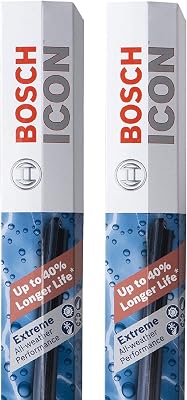
The ICON is the blade we would put on our own car. The beam design does what beam designs are supposed to do — no bracket joints to freeze, consistent contact across the sweep, and a quiet, chatter-free wipe on glass that is not perfectly flat. What sets it apart from other beam blades is the rubber, which holds its edge noticeably longer than average; owners routinely report a year or more before any streaking appears, in a category where six months is common. It is the most expensive of the three, and it is the one you replace least often.

These do something none of the others do: they continuously reapply a hydrophobic coating to your windshield as they sweep. In heavy rain at night, that is the single biggest improvement available to a windshield, because water beads and blows off the glass instead of sheeting across it and scattering oncoming headlights. The 119,000-review base tells you people buy them repeatedly. Two honest caveats: the repellent effect diminishes as the blade ages, so the benefit is front-loaded, and a small number of owners report initial squeaking on very clean glass that clears after a few cycles.

PARRATI is the value answer, and 24,800 reviews at 4.5 stars is a strong enough consensus that we are comfortable recommending a brand most people have not heard of. You get beam construction, a graphite-coated edge that runs quietly, and a pair in the box for close to what a single premium blade costs. The compromise is longevity — these do not hold their edge as long as the Bosch, and you should expect to replace them more often. If you drive a lot of miles or want to spend less per year, that math may still favour buying these twice.
| Pick | Construction | Standout feature | Sold as | Owner rating | Link |
|---|---|---|---|---|---|
| Bosch Best Overall |
Beam | Long-life rubber compound | Matched pair | 4.6★ (6,500+) | Check Price |
| Rain-X Best for Heavy Rain |
Beam-style | Applies water repellent while wiping | Single blade | 4.4★ (119,000+) | Check Price |
| PARRATI Best Value |
Beam-style | Beam design at budget pricing | Matched pair | 4.5★ (24,800+) | Check Price |
Wiper sizes are specific to your vehicle and the two sides are very often different lengths — a car might take a 26-inch driver and an 18-inch passenger. Your owner's manual lists both, every retailer has a lookup by year, make and model, and the simplest method of all is to pull the old blade and measure it end to end. Do not assume both sides match, and do not round up: a blade that is too long will collide with the other one or run off the edge of the glass.
Conventional blades use a metal bracket assembly to distribute pressure through several contact points. That works, but it leaves gaps in pressure across the sweep, the joints collect ice and snow in winter, and the frame catches wind at speed. Beam blades replace all of it with a single tensioned spine inside an aerodynamic shell — even pressure edge to edge, nothing to freeze, and less lift on the highway. On modern deeply curved windshields the difference in contact quality is easy to see.
Every blade wipes well when new. What separates a good blade from a cheap one is how long the edge stays sharp, and that comes down to the rubber and its coating. Silicone and treated natural rubber resist UV and ozone hardening better than untreated rubber. Graphite coatings reduce friction, which cuts chatter and slows wear. Expect roughly six to twelve months from most blades depending on climate — harsh sun and road salt both shorten that considerably.
This is one of the easiest jobs on a car and paying someone for it makes no sense. Lift the arm away from the glass until it locks upright, find the release tab where the blade meets the arm, press it and slide the blade off along the arm, then slide the new one on until it clicks. The one thing worth doing carefully: lay a towel on the glass while the arm is up. If a spring-loaded arm snaps back onto bare windshield, it can crack it, and that is a much more expensive afternoon.
The Bosch ICON is the best blade here and the one that lasts longest, which makes it the cheapest per month despite costing the most upfront. If you drive at night in heavy rain, the Rain-X Water Repellent blades do something genuinely different and are worth choosing for that alone. The PARRATI set gets you beam performance for budget money if you do not mind replacing them more often. Measure both sides before you order — that is the only part of this that people get wrong.
Fitting is a two-minute job once you know which connector you have. See how to replace windshield wipers, including how to avoid the sprung arm cracking your glass.
Prices change constantly, so we do not list them. These links go straight to each product on Amazon.
Bosch → Rain-X → PARRATI →Every six to twelve months for most drivers, but condition matters more than the calendar. Replace them when you see streaking, hear chattering, or notice areas the blade skips entirely. Hot sunny climates and salted winter roads both degrade rubber faster, so cars parked outside in Arizona or driven through Midwest winters will land at the shorter end of that range.
Check the owner's manual, use a retailer's fitment lookup with your year, make and model, or simply measure your existing blades end to end. The driver and passenger blades are frequently different sizes, so measure both. Some vehicles also take a separate rear blade in a completely different size and attachment style.
Lift the wiper arm off the glass until it stands upright, locate the small release tab at the connection point, press it and slide the old blade down and off the arm. Slide the new blade on in the same orientation until it clicks and gently tug to confirm it is latched. Lower the arm back onto the glass slowly rather than letting it snap down, and lay a towel over the windshield while you work in case the arm slips.
In almost all conditions, yes. Beam blades apply pressure evenly along their whole length, have no exposed joints to pack with ice, and generate less lift at highway speed. Conventional bracket blades are cheaper and still work adequately, but on modern curved windshields the beam design maintains noticeably better contact. The main reason to keep conventional blades is if your vehicle's arm design specifically requires them.
Usually the windshield rather than the blade. Road film, wax overspray and tree sap leave a residue that no blade will wipe through cleanly — clean the glass thoroughly with an automotive glass cleaner and a clay bar if needed, then wipe the blade edge itself with isopropyl alcohol. If streaking persists after that, check that the blade is fully latched and that the arm is applying even pressure; a bent arm will streak with any blade you fit.


Every product on this page was located and verified on Amazon at the time of writing — we confirm the exact listing, the star rating, the review count and stock status before a product goes in a roundup, and we never recommend a product we could not verify. Specifications come from the manufacturer listing, not from memory. We deliberately publish no prices, because they change faster than we can update pages. Ratings and review counts were accurate as of July 31, 2026.