

Tires & Wheels
Your car almost certainly has a tire pressure monitoring system, and it is not doing the job you think it is. Legislation in most markets requires TPMS to warn at roughly 25 percent below the placard pressure, which on a 35 PSI tire means the light appears at about 26 PSI. By then you have been driving on significantly underinflated tires for weeks — burning fuel, wearing the shoulders and lengthening your stopping distance the entire time.

A gauge costs very little and closes that gap. Check monthly, when the tires are cold, and you catch the slow loss every tire experiences long before a warning light would. The gauges below are separated less by accuracy claims — which are mostly similar and mostly unverifiable at this price — than by whether they are repeatable, readable in the dark, and hold a seal on the valve without hissing air away while you read them.
Accuracy claims in this category are stated in similar language by everyone and independently verified by almost nobody, so we weighted repeatability instead — whether a gauge gives the same reading three times in a row on the same valve, which is what owner reviews actually surface. Beyond that we looked at the valve chuck, since a poor seal bleeds air while you read and makes the measurement wrong in the one direction that matters, and at readability in low light, because tires get checked in the evening more often than at noon. We rejected listings under roughly 25 reviews. A gauge tells you the pressure; our guide to the best tire inflators covers correcting it, and the best tire repair kits cover the puncture that caused it.

JACO makes gauges as its main business rather than as one line among hundreds, and the difference shows in the chuck. A gauge that hisses while you take the reading is measuring the pressure after it has already let some out, and that failure is both common and invisible — you get a number, it is just the wrong one. The ElitePro seals positively and reads consistently across repeated measurements, which is the property that actually matters. The lit nozzle sounds like a gimmick until you are crouched behind a rear wheel in a dark driveway trying to find a valve stem by feel. At 4.7 stars it is the best-rated gauge we found with a serious review base.
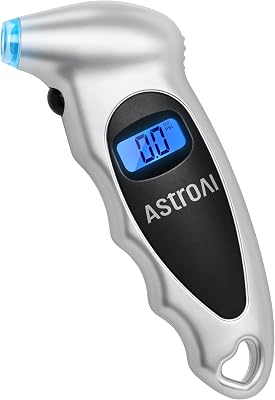
This is the gauge most people own, and we are including it with a caveat. Seventy-two thousand ratings is an enormous sample, and 4.4 stars across it is a real signal rather than noise — the recurring complaints are batteries draining in storage and units that stop holding a reading after a year or two. That is a meaningfully worse long-run record than the JACO. It is also cheap, widely available, accurate when new, and vastly better than not checking your pressures at all, which is the actual alternative for most people. Buy it knowing it is a consumable rather than a tool you will still be using in a decade.

The case for a mechanical gauge is simple: it is always ready. Every digital gauge in a glovebox is a small race between the next time you need it and the battery going flat, and that race is the single most common reason people give up on checking pressures. Vondior's dial gauge has nothing to die, is certified to an actual standard rather than a marketing claim, and is built heavily enough to survive being thrown around a trunk. It is slower to read than a digital and less precise between graduations. For a gauge that lives permanently in the car as a backup, those are the right trade-offs.
| Pick | Type | Range | Battery | Owner rating | Link |
|---|---|---|---|---|---|
| JACO Best Overall |
Digital, backlit | 100 PSI | Yes | 4.7★ (6,900+) | Check Price |
| AstroAI Most Popular |
Digital, backlit | 150 PSI | Yes | 4.4★ (72,000+) | Check Price |
| Vondior Best Mechanical |
Mechanical dial | 0-100 PSI | None | 4.5★ (7,400+) | Check Price |
This is the reason to own a gauge at all. Regulations generally require the warning light to trigger at around 25 percent below the recommended pressure, so on a car placarded at 35 PSI the light appears near 26 PSI. Fuel economy, tread wear and braking have all been degrading for a long time by then. TPMS is a safety backstop against a rapidly deflating tire, not a maintenance tool, and treating it as one is why so many cars drive around soft.
The number moulded into the sidewall is the tire's maximum pressure, not your car's recommended pressure, and inflating to it will give you a harsh ride, reduced grip and accelerated centre-tread wear. The correct figure is on a sticker inside the driver's door jamb, and sometimes in the glovebox or fuel filler flap. It is specific to your vehicle, and front and rear are often different.
Driving heats the air in a tire and raises the reading by several PSI, so a reading taken after a drive will flatter you into leaving a soft tire soft. Check before driving, or at least three hours after. Tires lose roughly 1 PSI a month naturally, and around 1 PSI for every 10 degree Fahrenheit drop in ambient temperature — which is why so many warning lights appear on the first cold morning of autumn.
Almost every gauge in this category claims within one PSI, and almost none of those claims are independently verified. What differs in practice is whether the chuck seals cleanly on the valve. A gauge that hisses is letting air out while it measures, giving you a reading that is both wrong and biased low — so you inflate to the wrong target. If you hear air escaping while taking a reading, the gauge is the problem, not the valve.
The JACO ElitePro is the gauge to buy — best-rated here, seals properly, and readable in the dark. The AstroAI is the one most people own and it is genuinely fine when new, but 4.4 stars across seventy-two thousand owners reflects real long-term reliability complaints and we would rather tell you that. If you want something that will simply work whenever you reach for it, the Vondior dial gauge has no battery to fail. Whichever you use, check cold, use the door placard, and do it monthly.
A gauge is only useful with the right number and the right moment. Our guide to checking tire pressure explains why you read them cold and why the door placard beats the number on the sidewall.
Prices change constantly, so we do not list them. These links go straight to each product on Amazon.
JACO → AstroAI → Vondior →Both can be accurate; the difference is in how they fail. A good digital gauge is easier to read precisely and typically claims tighter tolerance. A mechanical gauge has no battery and no electronics to drift, so it tends to stay usable longer with no attention. The most common real-world accuracy problem in either type is a poor valve seal rather than the measuring mechanism.
Use the figure on the sticker inside the driver's door jamb, which is specific to your vehicle and often differs front to rear. Do not use the number moulded into the tire sidewall — that is the tire's maximum safe pressure, not your car's recommended one, and inflating to it degrades ride and grip while wearing the centre of the tread.
Monthly, and before any long trip. Tires lose around 1 PSI a month through normal permeation regardless of punctures, and pressure drops roughly 1 PSI for every 10 degree Fahrenheit fall in temperature. Check when the tires are cold, meaning before driving or at least three hours after, since heat from driving inflates the reading.
No, and it is not designed to be. Most systems are required to warn only when pressure falls around 25 percent below the recommended figure, which is well past the point where handling, braking and fuel economy are affected. Treat it as an alert for a failing tire, not as a substitute for checking pressures yourself.
Air contracts as it cools, so pressure falls roughly 1 PSI for every 10 degree Fahrenheit drop in ambient temperature. A tire correctly set on a warm day can be several PSI low on the first cold morning of the season, which is why TPMS warnings cluster in autumn. It is normal physics rather than a leak — but do top the tires back up rather than waiting for it to warm again.


Every product on this page was located and verified on Amazon at the time of writing — we confirm the exact listing, the star rating, the review count and stock status before a product goes in a roundup, and we never recommend a product we could not verify. Specifications come from the manufacturer listing, not from memory. We deliberately publish no prices, because they change faster than we can update pages. Ratings and review counts were accurate as of August 8, 2026.